نوع مقاله : مقاله پژوهشی
نویسنده
دانش آموختۀ دکتری پژوهش هنر دانشگاه الزهرا
کلیدواژهها
عنوان مقاله English
نویسنده English
The art of embellishing Iranian ceramics and tiles has always captivated the attention of artists and craftsmen in this region. Among the various techniques employed to adorn pottery, the creation of Luster glaze (Zarinfam) stands out as the most significant and intricate method according to art experts. During the height of lusterware production in the 7th century A.H. (10th Century A.D.), Iranian artists, particularly those from Kashan, honed their skills and expertise in this field. They developed innovative approaches to crafting luster glaze, which they then utilized in the decoration of Iran's most sacred religious places. This article aims to explore and present five examples of luster tiles from Imamzadeh Ismail in Bideghan village, Qom province. Indeed, the collection is analyzed through a comparative and descriptive approach, and regarding historical sources. Among the tiles are one star-shaped tile with Fakhreddin's signature and dated 661 A.H (1262 A.D.), as well as four tiles with similar themes but without signature or date. Comparative studies reveal that the tiles belong to the Kashan school, and it is possible that they were created by the same artist during the same period.
Introduction
Imamzadeh Ismail is a renowned attraction for the locals of Qom, situated on a high mountain on the outskirts of Bideghan, approximately 55 kilometers southeast of this province. This historical mausoleum boasts exquisite doors, high-quality tiles, a shrine adorned with woodcarving, a dome, a portico, a courtyard, and a mosque. The mausoleum dates back to the 7th century A.H (11th Century A.D), and its original patron remains unknown. The tiles used in the tomb, particularly those with the faces of three horsemen, suggest that the founder of the mausoleum was either one of the rulers of Hulagu Khan or Nasir Al-Din Al-Tusi, his minister. The building's exterior is designed in the form of a multi-faceted tower, following the standard of that period, while the interior is a quadrilateral with a span of 5.50 and a height of 9 meters.
Nine pieces of tiles from Imamzadeh have been preserved and transferred to the Astaneh Museum of Qom. The collection under examination comprises five luster tiles, with four of them displaying a similar appearance. However, one of the tiles stands out due to its distinct design and inscription. Despite the extensive research conducted on Iranian tiles, particularly luster tiles, by Pope (2009), Keiger Smith (1985), Watson (2012), and others, including Ghanuni and Sadeghi Mehr (2017) on the Luster tiles of Hazrat Masoumeh's shrine, there has been no investigation regarding the luster tiles of Imamzadeh Ismail.
Methodology of the Study
The methodology employed in this study is of utmost importance as it serves the purpose of the research. The study falls under the category of historical research and the data has been collected through fieldwork and library studies. The analysis and interpretation of the findings have been carried out using the "historical approach" and comparative studies have been conducted to ensure its authenticity.
Four Decorated Luster Tiles
The set of painted tiles comprises four luster tiles, featuring a combination of cream and brown colors. Each tile measures 43 x 43 cm. These tiles do not bear any inscriptions but show various motifs, including plants, humans, and animals. One of the tiles depicts two individuals sitting across from each other in a garden adorned with flowers, leaves, and small birds. A pond filled with fish can be seen at the bottom of the image, while two birds stand facing each other at the top. The clothing, facial features, and halo surrounding the heads of the figures are reminiscent of the Kashan School. Furthermore, aside from the natural erosion and fading of the tile pattern, some parts have been damaged or broken. Particularly, the face of the person on the right appears to have been intentionally destroyed by human actions. In another tile, a central figure is surrounded by six other individuals. The central figure seems to hold significance as he is seated on a throne. Similar to the previous tile, there is a pond with fish at the bottom and two birds facing each other at the top. The characters' clothing is adorned with intricate patterns, and they have round faces, almond-shaped eyes, and halos around their heads.
The intricate design of comma-shaped patterns (Virgoli), Eslimi leaves, and Khata'i flowers, accompanied by birds perched or in flight, creates a picturesque garden in the mind of the viewer. Another tile in the array depicts a rider on a horse whose front legs are bent, causing the horse to slump or sit. The background of this tile is adorned with Virgoli patterns, meandering Eslimi, and small birds scattered throughout. The horse's body and the rider's attire are embellished with point decorations (Noghteh’i), virgoli, jewels, and triple points (Noghat-e-Seganeh). The rider has a Mongolian appearance, with long braided hair and a hat. The fourth tile in the series has faded over time, revealing only the faces of five individuals near the top of the tile.
A single Luster Tile Depicting the Revenge of KeyKhosrow
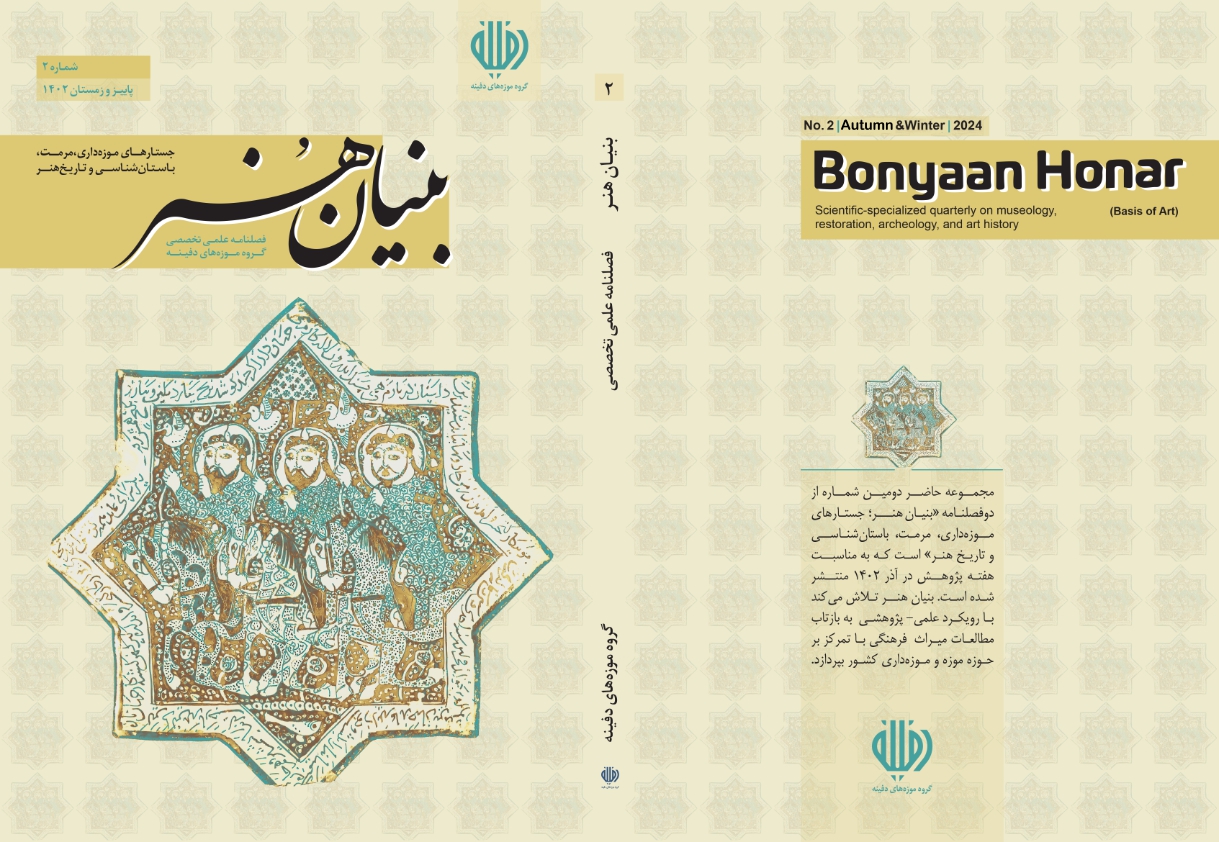
The tile is crafted in the conventional style of the 16-sided or octagonal tiles from the Ilkhanid period, measuring approximately 30 x 30 cm, which is slightly larger than the typical size of that period. The design of this tile is inspired by the tale of Siavash's vengeance by his son KeyKhosrow, featuring three horsemen wearing clothes with peacock eye motifs (Naghsh-e-Cheshm Tavoosi). The horses' bodies are embellished with scattered small and large dots within the frame. A white halo surrounds the riders' heads, while the riders themselves are depicted with detailed hair and beards, reflecting the characteristic style of drawing noble figures in the Kashan School. The almond-shaped eyes have unfortunately been damaged due to human Actions. This tile portrays a landscape with a pond where fish swim, and three birds soar above the heads of all three riders.
The tile bears an inscription from Ferdowsi's Shahnameh, recounting the epic battle between KeyKhosrow and Afrasiab, as KeyKhosrow seeks vengeance for the tragic death of his father, Siavash. This inscription serves as a tribute to Sultan Mahmud of Ghaznavi.
چو پیکار کیخسرو آمد پدید زمن جادویها بباید شنید
بدین داستان در ببارم همی به سنگ اندرون لاله کارم همی
جهاندار اگر چند کوشد بِرنج بتازد بکین و بنازد بگنج
همش رفت باید به دیگر سرای بماند همه کوشش ایدر به جای
تو از کار کیخسرو اندازهگیر کهن گشته کار جهان تازه گیر
که کین پدر باز جست از نیا به شمشیر و هم چاره و کیمیا
نیا را بکشت و خود ایدر نماند جهان نیز منشور او را نخواند
فخرالدین، سنة احدی و ستین و ستمائه .....
1.As the Keykhosrwo battle commences, lend an ear to my enchanting tales.
2.I shall recount narratives that bring forth tulips blooming within a solid stone.
The mighty ones may revel in their opulent existence driven by avarice and riches.
4.However, a time will arrive when they must bid farewell to this realm and embark on a journey to another world.
Take heed of Keykhosrow's fate, that it shall reveal the old secrets of the world.
for he yearned to avenge his father by seeking retribution against his grandfather.
Although he succeeded in slaying his grandfather, he did not survive, and the cosmos displayed no mercy towards him.
Fakhr-al-Din, Year Ahadi, Setein va Seta-Mae (661 A.H, 1262 A.D).
The Artist
The script known as Taliq was utilized for the inscription on this tile. Within the inscription, there are verses from Ferdowsi's Shahnameh describing KeyKhosrow, as well as the signature of Fakhr al-Din and the year 661 A.H (1262 A.D.). It is evident that the four tiles introduced in the initial section are most likely the works of Fakhr al-Din. The simultaneous execution and installation in a specific location, alongside the utilization of similar decorative elements, further supports our confidence in asserting that both sets of artworks were crafted by the same artist.
Conclusion
The significance of luster tiles in Iranian culture can be traced back to ancient times. Despite the devastating Mongol attack, the production of these tiles continued with a high level of quality and nationalistic themes, demonstrating the resilience and hope of Iranians after that tragic incident. In addition to their cultural and historical importance, the aesthetic and morphological aspects of these tiles are also noteworthy. The set of five tiles, including the single star-shaped tile with an inscription dating back to 661 A.H (1262 A.D.) and attributed to Fakhr al-Din, share a similar style and period. The motifs and decorative arrays of these tiles are also connected to the Kashan Lusterware School, as evidenced by Pope's reference to Fakhr al-Din's influence and production. The use of Ferdowsi's Shahnameh poems in a religious place further highlights the artistic and national features of Iranian culture. Overall, the examination of luster tiles provides valuable insights into Iranian art and culture.
کلیدواژهها English