نوع مقاله : مقاله پژوهشی
نویسنده
کلیدواژهها
عنوان مقاله English
Abstract
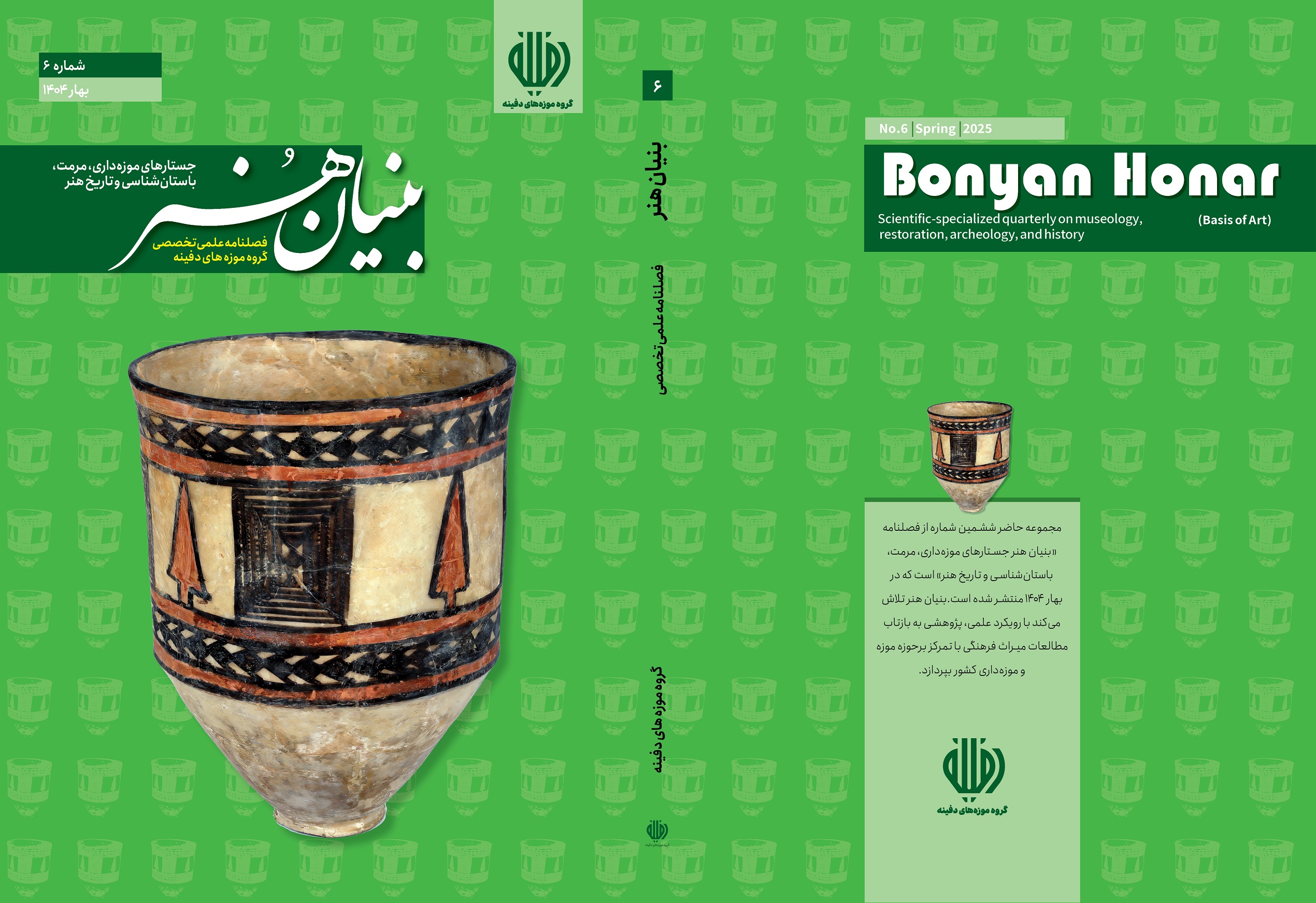
One of the artifacts on display in the Dafineh Museum Campus is a conical pottery vessel that was found through a non-scientific excavation. This 55-centimeter-high pottery vessel has high-quality creation and a thick, pea-colored clay coating, and is decorated with geometric designs. The central motif of the vessel is a stylized image of a cypress in ochre with black outlines, repeated three times on the body of the vessel. Three rectangular frames with linear designs are between the cypresses, and rows of interconnected diamonds are in the upper and lower bands of the basic design. The symmetry of the motifs with the three-part composition, in addition to creating balance and rhythm, has reduced the stillness of the design and increased its dynamism.
Considering the lack of information about the discovery context of the vessel, this study aims to investigate the historical-cultural period of the vessel in question. Accordingly, this study addresses its key question regarding the cultural period, artistic characteristics, and region of the pottery vessel. An examination of the form, creation style, and motifs of the vessel and its comparison with the pottery data obtained from archaeological excavations in the sites of Yahya, Varamin, Mahtoutabad, Qal’eh Ganj, and Dehno indicate that the vessel is close to the Halil Rud Basin in the late fourth millennium B.C. (3300 to 2900 B.C.). The period in the Halil Rud Basin is recognized as the Varamin culture (or the Varamin IV period in the Varamin site), whose pottery is influenced by the Aliabad pottery culture, and local and indigenous styles. Therefore, the conical pottery vessel can be associated with the Varamin culture dating back to the Early Bronze Age I in the Halil Rud Basin. The period coincides with Mahtoutabad III, Yahya IVc, and Bampur I-IV periods, and in southwestern Iran, with Susa III and Proto Elamite periods. This study was conducted using a descriptive-analytical method, and its methodology was based on library and field studies.
Introduction
Artifacts obtained from non-scientific excavations are generally considered unreliable from which it is difficult to extract information due to lack of context. In cases where the artifact has a unique and distinctive feature, it is possible to approximately determine the period and region of the artifact by conducting a comparative study of artifacts obtained from other sites that have been investigated archaeologically. The pottery vessel on display in the Iranian section of the Dafineh Museum Campus was obtained from a non-scientific excavation, on which no study has been conducted, and our information about its place of discovery, settlement layer, cultural and historical period is unreliable. Although, in the initial examination, the vessel has the characteristics of southeastern Iran cultures, particularly Kerman, it requires comparative studies.
The research question concerns the cultural period, cultural characteristics, and cultural region of the pottery. This study was conducted using a descriptive-analytical method, and its methodology was based on library and field studies to photograph, design, and compare the pottery vessel. The pottery data are comparable to the vessel under study in terms of pottery motifs, visual composition, and coordination in the created designs. Below, we will analyze and date the pottery vessel by recording the quantity and quality of the studied artifacts.
Introduction to the artifact
The pottery vessel under study, with the identification code 43434M, is kept in the Dafineh Museum Campus. The vessel has a height of 55 cm, a mouth diameter of 44 cm, and a base diameter of 13 cm. This handmade vessel is made of fine mineral chamotte, and is properly fired with a polished surface and a pea-colored clay glaze (Image 1). The surface of the pottery is decorated with geometric patterns in black and ochre. Since the vessel has a thick pea-colored clay glaze, it appears to have been painted in pea, black, and ochre, demonstrating the potter’s conscious use of the pea-colored background, so that they incorporated negatively into their final drawing.
The central motif is a stylized cypress in ochre with black outlines, repeated three times on the body of the vessel. In the space between the trees, three designs are drawn within a rectangular frame, two of which are concentric rectangles with a repeating black diamond motif in the center. The two designs have slight differences in the number of diamonds in the center of the rectangles. The other design is a combination of vertical and horizontal lines within a rectangular frame. On the top and bottom bands of the vessel, connected diamonds are painted in black, representing a pattern similar to a row of fish (Image 2). The symmetry of the motifs, in the form of a three-piece combination, has decreased the stillness of the pattern and increased its dynamism. Conical pottery vessels, considering their dimensions and size, were designed for storage purposes; however, their high-quality creation process, firing method, and decorations indicate that they were used not only for storage purposes, but also for special purposes such as lavish ceremonies.
Varamin pottery culture (Varamin IV) and its cultural similarity with the conical pottery vessel
In the chronology of the Halil Rud Basin, after the Aliabad period, evidence of indigenous and local factors was obtained, which is known as the Varamin period (Moradi, 2021: 227). The period in Tepe Varamin covers a period from 3300 to 2900 B.C., and its pottery is known in two ranges: the pottery tradition of the previous period (the Aliabad culture), and the tradition of indigenous pottery (Eskandari, 2020: 37-42).
Aliabad pieces of pottery dating back to 3800 to 3300 B.C. were obtained from a wide geographical area, including the Shahdad Plain, the Halil Rud Valley (sites such as southern Konar Sandal Tepe and Mahtoutabad II), Makran, Baluchistan of Iran, and Baluchistan of Pakistan (Mola Salehi et al., 2014: 59-60). The Aliabad culture includes five groups of pottery: plain Aliabad, painted Aliabad, bicolor Aliabad, polished Aliabad, and embossed Aliabad (Caldwell, 1967: 182-188). Except for the embossed Aliabad pottery, all other pieces of Aliabad pottery are handmade with a thick pea-colored clay glaze to cover the pottery. Aliabad pottery designs are geometric and without elegance, created in black and red or black and green on a pea-colored background (Voigt and Dyson, 2003: 76-77). Examples of Aliabad pottery can be observed at Tepe Yahya, Layer IVc (Lamberg-Karlovsky and Potts, 2001: 66), Mahtoutabad, Layer III (Desset et al., 2013: 38), Khaje Asgar Cemetery (Mola Salehi et al., 2014: 56), and Miri Qalat, Layer IIIa (Moradi, 2021: 223).
The indigenous pottery tradition in the Varamin pottery culture includes thick, hand-made vessels painted with thick, uniform brush strokes. Although the designs are relatively simple and repetitive, they are more regular and visually balanced than those of the Aliabad pottery. The designs include diamond chains, triangles, crosses, decorative arches, and hourglass designs created with diagonal or intersecting lines in dark brown and orange. A number of indigenous Varamin pottery have been obtained from the Varamin site Layer IV, and the Rig Anbar Cemetery (Eskandari et al., 2021: 11).
In terms of form and design, the vessel is very similar to the Varamin culture in the chronology of the Halil Rud Basin or the Varamin IV period in the Varamin site. The Varamin period in the chronology of southeastern Iran coincides with Yahya IVc, Bampur I-IV, and Iblis IV (Eskandari, 2020: 50). The form, designs, and creation method of the vessel can be observed in the vessels of the Varamin site. Some designs of the vessel are similar to those of the pottery obtained from Yahya, Dehno and Qal’eh Ganj sites (Image 4). However, the central motif of the vessel, which is a stylized cypress motif, was not found from the aforementioned contemporaneous sites. Although, examples close to this motif were obtained from the Susa III period (Le Breton, 1957; Plate, XXVI), the motif appears to be indigenous and local.
Conclusion
The study of artifacts and data obtained from non-scientific excavations is largely based on probabilities and assumptions, making it challenging to rely on the artifacts, even if some of them are considered historical indicators.
One of the artifacts is a conical pottery vessel found in the Dafineh Museum Campus. This handmade vessel has a height of 55 cm, and enjoys an excellent creation process, thick clay coating, and geometric designs in black and ochre. The designs used in this vessel are clearly derived from contemporary designs, as well as the indigenous characteristics of the region. An examination of the form, creation style, and motifs of the vessel compared with the pottery data of archaeological excavations in Yahya, Varamin, Mahtoutabad, Qal’eh Ganj, and Dehno sites reveals that the vessel is extremely close to the Halil Rud Basin in the late fourth millennium B.C. (3300 to 2900 B.C.). The period in the Halil Rud Basin is recognized as the Varamin culture (or the Varamin IV period in the Varamin site). The pottery of the period is under the influence of the pottery culture of the previous period, namely the Aliabad culture, and indigenous and local styles. The comparison of the conical pottery vessel with the data obtained from the Varamin site reveals remarkable similarities. Thus, it can be concluded that the vessel belongs to the Varamin culture in the Halil Rud Basin in the Early Bronze Age I period.
کلیدواژهها English