Document Type : Original Article
Author
Iran art museum
Abstract
Textiles represent one of the most delicate forms of artistic expression found in museums. Textiles made from either plant or animal fibers are particularly vulnerable to breakage and damage in both the warp and weft, influenced by the specific type of fiber used. External pressures can lead to stretching and interweaving of these fibers, resulting in alterations in shape, as well as distortion and elongation in both the length and width of the weave. Additionally, these fibers possess a significant capacity to absorb moisture and pollutants, underscoring the critical importance of proper maintenance and display of all fabric types. Currently, numerous museums worldwide employ specialized or case-by-case methods to preserve and exhibit woven artworks. However, many of these institutions struggle to effectively exhibit such works. The high acidity of the fibers, coupled with potential damage from microorganisms, renders older textiles particularly fragile and susceptible to breakage even under minimal pressure. Consequently, specialized conservators dedicate considerable time and effort to the preservation and treatment of these items. Key factors in the optimal care of woven works include the regulation of environmental conditions such as temperature, humidity, and light intensity. Furthermore, the implementation of standard storage and display methods significantly contributes to extending the lifespan of historical textiles. It is widely recognized that the most suitable approach for displaying weaves is to position them horizontally within display cases, as this allows for an even distribution of weight across the entire surface. However, due to space constraints, museum professionals and conservators often resort to vertical displays. This article addresses the best practices for exhibiting textiles vertically in a museum setting, exploring strategies to minimize damage while simultaneously ensuring an aesthetically pleasing presentation for visitors.
Keywords: Textile, Pateh, Termeh, Textile Restoration, Textile in Museums, Museum Exhibition, Museum of Iranian Art
Introduction
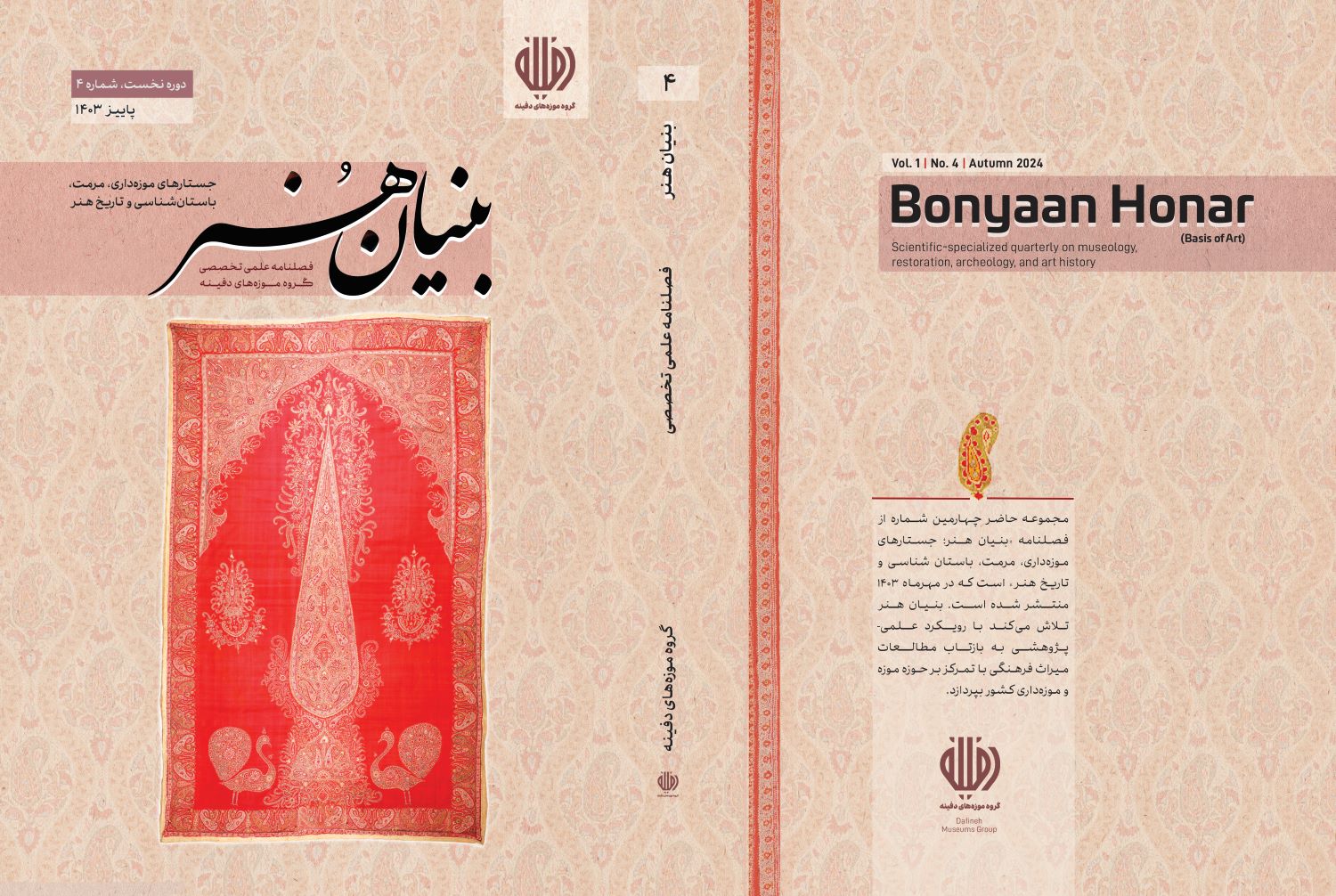
The Toranj Hall of Museum of Iranian Art shows a diverse collection of historical hand-woven textiles, including rugs and various forms of embroidery such as pateh, sermeh, pearl (morvarid), and golabaton. This article primarily focuses on two historical textiles: termeh and pateh, which will be elaborated on in the following sections. Given the limited space of the Toranj Hall, the exhibition of woven works necessitated a vertical display method, with the selected pieces mounted on the walls. Acknowledging the potential harm that vertical display poses to the fabrics, the restorers were tasked with identifying and implementing the most effective technique to minimize damage. Both termeh and pateh represent artistic and textile traditions shared by Iran and India, although their precise origins and historical emergence remain uncertain. It is evident that both termeh and pateh flourished during the Safavid period, each being distinctive and exceptional in its own right. Kerman province, located in Iran's desert region, is renowned for its beauty. In literature, "termeh" typically refers to shawls or cashmere shawls. Another notable textile from Kerman with a rich history is "pateh." The two historical textiles discussed in this article include a hand-woven and sermeh embroidered Qajar termeh and a hand-embroidered pateh featuring a design of forty parrots. The Qajar termeh features a boteh design, measuring 86 x 66 cm, adorned with "embroidery" decorations that incorporate gold, silver, and pearl, showing a symmetrical floral and bush motif. Additionally, pateh, which measures 147 x 215 cm, is crafted in the Kerman region and is typically utilized as a curtain to help regulate room temperature. The examined piece is woven from fine goat hair with a crimson red background, and its intricate and exquisite embroideries are the work of talented women artists from Kerman.
Discussion
Currently, various scientific and recommended techniques are outlined in most conservation and restoration manuals for the vertical display of textile pieces. The most prevalent method involves the application of “velcro tape” to the reverse side of the artwork, which is then adhered to the supporting surface. While this technique offers several advantages, such as the ease of detaching the artwork from the support and the absence of direct clips or fasteners that could damage delicate textures like pateh and termeh, it can also lead to distortion and alteration of the textile's shape over time. Preliminary investigations revealed that both the pateh and termeh pieces were in satisfactory physical condition, with the threads exhibiting strong cohesion. The primary concern, however, was the method of exhibition. After evaluating common techniques, including the use of velcro and considering their respective pros and cons, it was determined that an innovative approach, inspired by previous methods, would be employed to ensure the careful display of these delicate works. Further details regarding this implementation method will be provided below.
Following the routine cleaning of the artworks, which involves dry cleaning and the removal of dust with a suction apparatus equipped with a cloth net, surface stains were treated locally with a detergent (baby shampoo) and appropriate solvents (ethanol and acetone). Subsequently, the gold embroidery was cleaned using distilled water and ethanol, after which all metal embellishments were secured with a 5% paraloid solution. Additionally, a section of the linings' stitching was unpicked, and these areas were resewn.
Subsequently, the stage of tissue transfer started on the hard support. The inclusion of a hard support not only reduces the tension on the fabric but also absorbs a portion of the pressure exerted by the weight of the artwork on the warp and weft. Prior to the transfer, an appropriate cotton cloth was prepared to serve as a support and was affixed to the rear of the artwork in a suitable manner. In the following step, the fabric, along with its supporting cloth, was stretched and secured on the pre-prepared support, which consisted of a polycarbonate sheet, on all four sides. To mitigate the flexibility of the support layer and to protect the artwork from shocks, the support layer, along with the fabric affixed to it, was attached to a wooden frame that was crafted to the precise dimensions of the artwork. Finally, the assembled frame was positioned so that a slight border of the piece was concealed, and the fasteners intended for wall attachment were installed at the back of the frames.
Conclusion
Approximately four years have elapsed since the exhibition of the mentioned works, and their condition remains favorable. Concerns regarding the potential rejection of stitches, applied pressure, and alterations in the warp and weft have been investigated, revealing that these changes are minimal and within acceptable limits. It is recommended that the exhibited works be placed in a resting position every six months to a year and be relocated with other pieces during this interval. In accordance with textile preservation practices, no textile work should be displayed indefinitely; provisions for moving the work and transferring it to a quarantine area for rest should be established. The guidelines set forth by the specialized committee on textiles and clothing indicate that the ideal temperature for textile storage is 18 degrees Celsius, with a relative humidity of 50-55%. It is imperative to eliminate ambient light and regulate light intensity, with a maximum permissible illumination of 50 lux for fabric exposure. As previously noted, ensuring proper air circulation and maintaining a clean environment are critical factors.
Keywords
Subjects