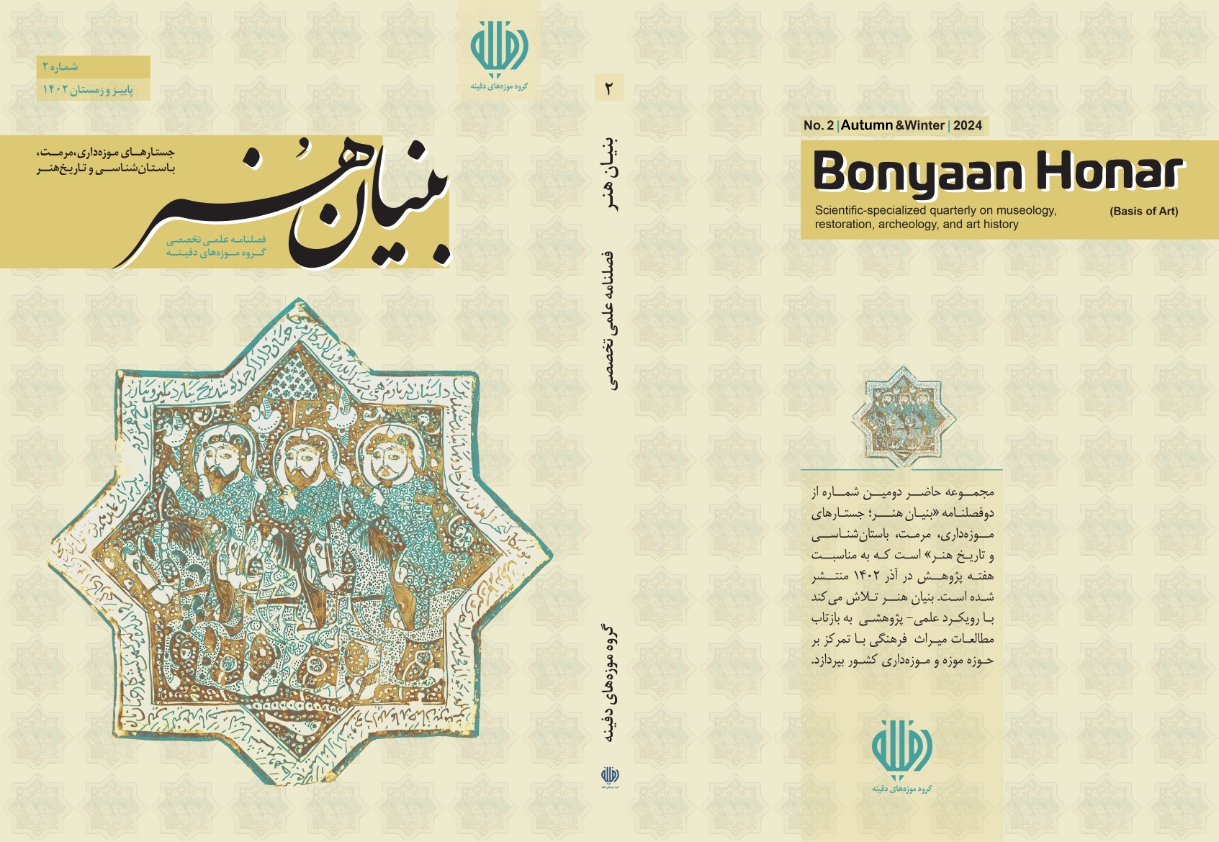
Typology of shape and design in Silhouettes of the Islamic Middle Ages (6th-7th centuries A.H.) Preserved at the Cultural Institution of Museums of the Mostazafan Foundation

Document Type : Original Article

Authors

دکترای باستان شناسی دوران اسلامی، مؤسسه فرهنگی موزه های بنیاد، اداره پژوهش

Abstract
During the first half of the 5th century A.H. (10th century A.D), the Seljuk rose to power and conquered vast Islamic territories from the Jeyhoon River to the Mediterranean Sea, which led to the downfall of feudalism and the revival of the Sassanid kingdom. With political stability and economic prosperity, the pottery industry flourished and advanced in terms of production and decoration. The creation of a multitude of potteries with diverse colors and intricate decorations was facilitated by the endorsement of courtiers and the upper classes, along with the acquisition of artistic products and the establishment of trade and cultural connections with China. This flourishing artistic movement was further amplified by a meticulous comprehension of color, exceptional decorative skills, and an ardent commitment to achieving equilibrium and harmony. Consequently, these captivating potteries not only contributed to the advancement of other artificial arts like metalwork, painting, and book design but also played a pivotal role in their growth.
       During the 6th century A.H., porcelain was manufactured using a combination of materials such as quartz powder, soft soil, and potash. This mixture resulted in a white base that served as a canvas for a wide range of decorative motifs. The primary hub for porcelain production was Kashan, while Neyshabur, Samarkand, and Bamyan also played significant roles in its manufacturing. In this era, an alkaline glaze was preferred over lead glaze due to its compatibility with the porcelain body. This glaze imparted a beautiful turquoise-blue color to the earthenware surfaces, and its smooth, glass-like texture allowed for intricately engraved designs to be created.
Among the types of engraved decorations in the 6th century, Silhouettes stand out due to their shadowy appearance. These designs were crafted in black color beneath either ivory or turquoise blue glaze, making them truly unique. This pottery represents a shift from traditional to contemporary styles and draws inspiration from slip-painted pottery. It shows an array of geometric, botanical, zoological, and anthropomorphic patterns, layered in a captivating manner. The Seljuk to Ilkhani period is renowned for its exceptional pottery, and this particular technique is considered a prime example of its excellence. Interestingly, it also displays some similarities with Toreutics art. Engraving ceramic underglaze to create figural motifs and calligraphy is a complex and challenging process that involves removing parts of the glaze under the turquoise and ivory glaze to achieve the desired black color effect. In addition to engraving, underglaze painting is also utilized for the silhouette pattern, which is less common than the carved pattern. The underglaze is adorned with turquoise, blue, azure, and transparent cream inscriptions, as well as simple plant or geometric motifs in small sizes.
       Based on research and the evidence in museums of Iran and other parts of the world, silhouette pottery can be categorized into nine distinct groups. These groups include bowls, pitchers, vases, Albarello (medicine containers), money pots, plates, mugs, and jars, listed in order of their abundance. Each group has its own unique dimensions and details, making them different from one another. Furthermore, these groups can be further divided into subgroups based on their specific uses.
       Kashan, Ray, Gorgan, Neyshabur, and Sirjan are widely recognized as the primary centers for the production and discovery of this particular style of pottery. Furthermore, recent archaeological excavations and surveys conducted in various sites, including Zolf-Abad in Farahan, Tahayq in Khomein, Moshkin-Tepe in Zarandieh, Aweh in Saveh, Anda-jin and Zino-Abad in Hamedan, and Qal´ eh Sang in Sirjan, have yielded remarkable examples of silhouette pottery.
       Different types of decorative elements are incorporated into the artwork, encompassing, anthropomorphic, zoological, mythological, botanical, geometric, and calligraphic patterns. Additionally, a wide range of decorative designs like banquet scenes, romance scenes, hunting scenes, flowers, plants, and Persian poems are utilized. The majority of human figures are depicted on the ivory glaze, engaging in activities such as dancing, sitting, riding horses, and playing music. These figures are often portrayed without intricate facial details. Animal figures, on the other hand, consist of horses, deer, rabbits, ducks, fish, hounds, wild animals, and birds in mid-air.
Mythical creatures such as the sphinx, griffin, and harpy are formed by combining the unique characteristics of various animals to create a symbolic concept. Abstract botanical designs, inspired by nature, are seen in works by Khata'i, Eslimi, Toomari, and Tak. The motifs on containers can be either raised or drawn inside or outside. Geometric patterns, such as stripes, are often used as space dividers and add to the beauty of a vase. Kufic calligraphy, Naskh-e-Shekasteh, and Thulth are commonly engraved on the inner body, bottom, and outer edge of containers, often with themes of good prayer and hadiths for the holder.
       At the Cultural Institution of Museums of the Mostazafan Foundation, a total of twelve potteries have been analyzed. These containers come in various shapes such as bowl (3), bottle (2), pitcher (2), money pot (1), mug (1), vase (1), jar (1), and plate (1). The pottery designs feature a range of patterns including plant, animal, and bird, human, mythological, calligraphic, and geometric figures. Among the eleven decorated dishes, there are Eslimi designs such as Dahan-Azhdari, floral (goldar), ivy (pichak-dar), leafy (barg-dar), and palmette (Nakhl). There are six samples adorned with depictions of a horse galloping and racing, a rabbit leaping, birds in a face-to-face stance, and a horse with a rider in motion. The shattered container shows a composite figure, featuring a lion's body, an eagle's wings, and a human head (known as a Sphinx). This amalgamation of distinct characteristics from various creatures gives rise to a remarkable phenomenon, embodying the strength and finesse of these creatures. There are two instances where inscriptions in Knotted Kufic Script (Kufi-e-Gereh-Dar) and simple thulth (Thulth-e-Saddeh), can be found. These inscriptions contain the phrases Al-Dawlah, Al-Ezza, and Al-Karamah Lasahiba. Additionally, all the vessels are adorned with narrow or thick horizontal and vertical bands, small asymmetrical rhombuses, vertical wavy lines, thick grooves, and fragmented lines.
       This research aims to identify the stylistic and structural features of Silhouette pottery in the 6th and 7th centuries AH (10th and 11th centuries A.D) and analyze the concepts of its motifs. The study was conducted using a descriptive and data analysis method, examining the physical and tangible aspects of the pottery as well as conducting comparative library and documentary studies. The main question of the research is how this type of pottery is made and decorated, and what are the concepts behind its motifs? Twelve samples of Silhouette pottery from the Cultural Institution of Museums of the Mostazafan Foundation were used as the basis for the research. The results show that in terms of typology, the pottery includes bowls, vases, pots, albarellos, jars, plates, money pots, and pitchers. The main centers of production and discovery were the cities of Kashan, Rey, Jorjan, Neyshabur, and Sirjan. The decorative elements include geometric patterns (12 cases), botanical motifs (11 cases), animal motifs (6 cases), calligraphies (2 cases), anthropomorphic motifs (1 case), and mythological motifs (1 case).

Keywords

Subjects
  • Bibliography

    • Abbasian, Mir Mohammad (2000). The History of Pottery and Tiles in Iran from the antiquity to the Present. Tehran: Gutenberg
    • Akbari, Fatemeh (2003). The art of pottery and the study of motifs on it. Modares-e-Honar, 1 (3).
    • Amirhajloo, S., & Sedighian, H. (2020). Archaeological Research on Islamic Pottery from Qal´eh Sang, Old Sirjan (Kerman Province, Iran). pazhoheshha-ye Bastan shenasi Iran, 10(25), 155-180.
    • Ammarzadeh Esfahani, Hossein (1991). Tarikh-e-Mofasal-e-Iran. Tehran: Islam.
    • Azami, Z., Sheikhol hokamae, M. A., & Sheikhol hokamaei, T. (2014). A Comparative Study of Stucco Design and plants Motifs in Ctesiphon Palace and Early Iranian Mosques (Mosque of Naien, Mosque of Ardestan, Mosque of Isfahan). Journal of Fine Arts: Visual Arts, 18(4), 15-24.
    • Bandari Esfahani, Qavam al-Din Fateh bin Ali bin Mohammad (1977). History of the Seljuq Dynasties. Translated by Mohammad Hossein Jalili, Tehran: Bonyad Farhang Iran.
    • Bayhaqi, Abulhasan Ali bin Zayd (1982). History of Bayhaq (Tarikh-i Bayhaq). Edited by Ahmad Bahmanyar, Tehran: Foroughi.
    • Brand, Barbara (2004). Islamic Art. Translated by Mahnaz Shaistefar, Tehran: Institute of Islamic Art Studies (Original work published 1944).
    • Changiz, S., & Rezaloo, R. (2012). Symbolic Evaluation of Animal motifs in Nishapur pottery (3th - 4th century AH). Journal of Fine Arts: Visual Arts, 4(47), 33-44.
    • CHitsazian, A.H., & Saadat Mirghadim, S.N.. (2010). Stastistical Examination of Kashan Potteries (Ilkhanid Period) On the Base of Anne Shebberd Ideas. Naghsh Mayeh, 3(5), 61-66.
    • Clifford Edmund, Bosworth (2001) The Cambridge History of Iran, Vol. 4: From the Arab Invasion to the Saljuqs. Translated by Hassan Anousheh, Tehran: Amir Kabir (Original work published 1968).
    • Dadvar, A. (2014). Plant and Animal Motifs and Symbols in Potteries of Islamic Period in Iran. Negarineh Islamic Art, 1(4), 4-18.
    • Dadvar, Abolqasem and Elham Mansouri (2011). Myths and Symbols of Iran and India, Tehran: Al-Zahra University.
    • Dehkhoda, Ali Akbar (1951). Under the supervision of Dr. Mohammad Moein. Tehran: Golshan Offset Publication.
    • Dimand, Maurice Sven (1957). A handbook of muhammadan art. Translated by Abdullah Faryar, Tehran: Elmi Farhangi (Original work published 1944).
    • Ettinghausen, Richard (1999) Iranian art in the Seljuk period. Translated by Yaqub Azhand, Bahman, No. 139, 56-50.
    • Ettinghausen, Richard and Grabar, Oleg (2009). The Art and Architecture of Islam 1, translated by: Yaqub Azhand, Tehran:SAMT (Original work published 2001).
    • Grabar, Oleg (2006). Visual arts, Cambridge History of Iran, volume 4. Translated by Hassan Anoushe, Tehran, Amirkabir.
    • Grubeh, Ernest (2005). Islamic Pottery (the seventh volume of the ten-volume collection of Islamic art), Translated by: Farnaz Haeri, Tehran: Karang.
    • Haidar nattaj, V., & Maghsoudy, M. (2019). Impression of Plant Motifs Common Contents of Iran’s Pre-Islamic Architecture on Islamic Architecture Schemes (Respect to Umayyad and abbasid periods). The Monthly Scientific Journal of Bagh-e Nazar, 16(71), 35-50.
    • Helmi, Ahmad Kamal al-Din (2004). Seljuk government, translation and additions by Abdullah Taheri et al, Qom: Research Institute of Hawzeh and University.
    • Heydari, Reza (2008). Preliminary report of the third season of excavation of Tepe Rabat 2, Sardasht, West Azarbaijan. Archive of Cultural Heritage, Tourism and Handicrafts of West Azarbaijan.
    • Hoseyny, H. (2013). Reflection and analyses of composed animals in Islamic pottery of Iran. Journal of Fine Arts: Visual Arts, 17, 54-45.
    • Ibn Athir, Izz al-Din (1987). Al-Kāmil fī al-tārīkh, The Great History of Islam and Iran, translated by: Ali Hashemi Haeri and Abulqasem Halat, Tehran: Elmi Publications.
    • Katli, Margrina & Louis Hambis (1997). Encyclopedia of art (Seljuk art), translated by: Yaghub Azhand, Tehran:
    • katoei zadeh, Zohre (2014). Introduction and study of the technique of underglaze carved pottery with silhouette decoration (a case study of the pottery found in the Cultural Institute of Mustafafan Foundation Museums), master's thesis in archeology, Islamic Azad University of Tehran Markaz.
    • Kayani, Mohammad Yusuf (2001). Iranian pottery a historical background. Tehran, Nasim Danesh
    • Khaledian, Sattar (2008). The influence of Sasanian art on pottery of the Islamic period, Bastan-Pazhohi, Spring, No. 16.
    • khazri, M. M. (2017). Study of the Scripts and Decorations of the Kufic and Thuluth Inscriptions on Iranian Metal Containers in Seljuk Territory. Journal of Great Khorasan, 7(25), 29-50.
    • Khosravi, Elaheh. (2012). The Survey of Bird's Figures and Forms in the Ancient Art of Iran. Naghsh Mayeh, 5(11), 69-84.
    • Lambton, Ann Catherine (2001). The Cambridge History of Iran, Vol. 5: The Saljuq and Mongol Periods, Cambridge History of Iran, vol.5, compiled by J.A. Boyle. Translated by: Hassan Anousheh, Tehran: Amirkabir (Original work published 1968).
    • Machiani, Hossein Ali (2001). Instructing Patterns and Illumination. Tehran: Yassavoli.
    • Mahjoubi, Fatemeh & Tandi, Ahmed (2016). Survey and analysis of Silhouette pottery in Seljuk era and its importance in Iranian culture. First National Conference of Archeology and Pottery Art, 1076-1066.
    • Mahjour, f., & Sedighian, h. (2009). The Review on Islamic Potteries from the Site of Moshkin Tape, Parandak in Markazi Province. Payam-e Bastanshenas, 6(12), 105-120.
    • Meshkoti, Nasrallah (1964). From Seljuk to Safavid. Tehran, Iran Commercial Bank Printing House.
    • Mohammadi, M., & rezaei, M. (2022). A Survey and Typological analysis of pottery in the Andajin site of The Hamedan plain in Seljuk and Ilkhanid periods. Journal of Islamic Archaeology studies, 2(2), 95-116.
    • Mohammadi, M., & Shabani, M. (2016). An Introduction and Analyses of Islamic Pottery of Zino-Abad, Bahar County, Hamadan Province. pazhoheshha-ye Bastan shenasi Iran, 6 (11), 135-150.
    • Mollazade, K. (2013). Introduction, study and dating of discovered pedestal in Bukān. Iranian Studies, 2(2), 73-87.
    • Morgan, D. (2014). Medieval Persia 1040-1797. Translated by Farrokh Javanmardian, Tehran: Faravahar Publications (Original work published 1988).
    • Mortezaei, Mohammad and Kayani, Youssef (2006). Study and analysis of potteries from archaeological excavations of 1381 to 1384, archaeological site of Jurjan. Faculty of Literature and Humanities, University of Tehran, No. 108: 111-129.
    • Mortezayi, Mohammad, & Sedaghatizadeh, Neda. (2012). Study of Animal Motifs of Ancient Potteries of Gurgan City (Jurjan) During Islamic Period. Pazhohesh-Ha-Ye Bastanshenasi Iran, 2(2), 47-62.
    • Moshabaki isfahani, A., & safaee, N. (2016). The Genesis of Plant Artifacts in the Art of Islam (Special decoration to the Arabesque and Khatay designs). Negarineh Islamic Art, 3(10), 32-40.
    • Nadim, Farnaz (2007). A Look at Decorative Motifs in Iranian Art, Art, Volume 4, Number 10, 14-19.
    • Nekunam, Javad (2013). Comparative study of Iran's terracotta and metal volumes in the 5th and 6th centuries of A.H., Ketab Mah Honar, No. 18: 82-102.
    • Nemati, M., esmaeil, S., & sadraei, A. (2020). Research on Molded Pottery in Zolfaabad Site of Farahan. Pazhoheshha-ye Bastan shenasi Iran, 10(26), 119-140.
    • Nemati, Mohammad Reza and Sedikian, Hossein and Ebrahimi Nia, Mohammad (2010). Survey of pottery in Zolf Abad, Farahan, Markazi Province (first season of Excavation). Archeology of Iran, No. 3.
    • Pope, Arto Upham and Philip Ackerman (2008). Survey of Iranian Art from Prehistory to the contemporary, Volume 4, edited by Siros Parham, Tehran: ElmiFarhangi.
    • Qavidel, Azam (2003). Study of Seljuk era terracotta motifs. Unpublished master's thesis, Al-Zahra University.
    • Rawandi, Muhammad bin Suleiman (1985). Rahat al-sudur wa-ayat al-surur in the history of the Seljuq dynasty. Corrected by Muhammad Iqbal, vol. 2, Tehran: Amir Kabir
    • Riazi, Mohammad Reza (1996). illustrated dictionary of Iranian art terms, Tehran: Al-Zahra University
    • Rice, Talbot (2007). Iranian heritage. Translated by Ahmad Birshak, Tehran: Elmi Farhangi.
    • Shafie Sararodi, Mehrnoosh, & Maaleki Moghaddam, Mohaddese. (2019). The Morphological Analysis of Pottery Pitchers of the Middle Islamic Period of Kashan. NEGAREH, 14(51 ), 65-81.
    • Sharahi I, Sedighian H. (2019). Archaeological Investigation of Medieval Islamic Potteries from Troglodytic Structure of Tahigh, Khomein. Parseh J Archaeol Stud. 3(8), 141-158.
    • Sharif Kazemi, Khadijah (2012). Study of the sgraffito pottery technique and the pottery collection of Foundation Museums Institute. Unpublished master's thesis, Ibn Sina University.
    • Sharifzadeh, M., & Feizi Moghaddam, E. (2018). A Comparative Study of the Sphinx in Achaemenid Art and Seljuk Art. The Monthly Scientific Journal of Bagh-e Nazar, 15(64), 53-70.
    • Shatari, Mitra, 2014, the background of slip-painted pottery and its effect on silhouette and lak-Abi The first international conference on tourism, geography and archeology.
    • Sheppard, A. (2006). Aesthetics: An Introduction to the Philosophy of Art. Translated by Ali Ramin, Tehran: Elmi Farhangi (Origianl work published 1987).
    • Shirazi, Mena (2016). Botanical Patterns in ancient vases. The fourth national conference on architecture and urban planning; Sustainability and resilience, from ideal to reality. Islamic Azad University of Qazvin.
    • Shrouh, A. Vanushfar (1999). Glaze, tile, pottery. Tehran: Gutenberg.
    • Sohrabi nia, A., & taghavi, A. (2019). Ancient City of Sirjan during 7th-8th Centuries AH Citing Historical Evidence and Pottery Findings. Journal of Archaeological Studies, 11(2), 153-169.
    • Tosali Roknabadi, Maryam (2014). The Origin and Evolution of silhouette Pottery. Unpublished master's thesis, Department of Archeology, University of Kashan.
    • Towhidi, Fageh (2006). The basics of metalwork, painting, pottery, weaving and textiles, architecture and calligraphy. Tehran: Samira.
    • Towhidi, Fageh (2011). Pottery technique and art. Tehran: SAMT.
    • Vasal, Zainab (2007). Study of the role of birds in the Islamic era pottery hall of the National Museum of Iran, spring, 5.
    • Yahaghi, Mohammad Jaafar (2010). The Dictionary of Myths and Fiction in Persian Literature. Tehran: Farhang Markaz.
    • Youssef Vand, Yunus and Miri, Farshad (2015). A Comparative Study of Stucco Decorations Discovered from the Historical City of DarehShahr with Examples Available in Jameh Mosque of Nain, Negreh, No. 39: 34-4.
    • Zaki, Mohammad Hassan (1941). Iran's industries after Islam. Translated by Mohammad Ali Khalili, Tehran: Eghbal.
    • Zaki, Mohammad Hassan (1984). History of Islamic Arts, translated by Mohammad Ali Khalili, Tehran: Eghbal.
    • Zaki, Mohammad Hassan (1998). Iranian Pottery from the Prehistoric Period to the Present Age. Tehran, Yassavoli.
    • Zamani, Abbas (1973). Arabesque and Eslimi designs in historical works of Iran. Art and People, No. 126, 17-34.