Analysis of Visual Elements in Saqqakhaneh School Painting (Case Study: The Sacred-Mystical Works of Hossein Zenderoudi)

10.22034/ciom.2025.2068202.1047

Document Type : Original Article

Authors

1 Assistant Professor, Department of Archeology and History, Faculty of Literature and Humanities, University of Neyshabur, Iran

2 Master's student, Department of Painting, Ferdows Institute of Higher Education, Mashhad, Iran

Abstract
This research aims to analyze the visual elements (color, line, form, texture and space, shape) in the paintings of Hossein Zenderoudi, as one of the founders of the Saqqakhaneh School, focusing on five of his prominent works. The primary research question centers on how traditional visual elements are redefined within the framework of modern Iranian art and their role in creating a national-international identity. Adopting a descriptive-analytical method, data was collected through direct study of the artworks and analysis of their visual structures. The findings reveal that Zenderoudi achieved a distinct visual language by skillfully integrating religious symbols, elements of folk art, and Persian calligraphy with modern abstract forms. In the examined works, line (particularly thuluth script) transcends its linguistic function to become a visual element redefined through rhythmic compositions, dynamic symmetries, and demarcated color planes (purposeful use of warm and cool colors). Specifically, sacred geometry (the circle as a symbol of the cosmos, vertical rectangles reminiscent of epigraphy) and mystical concepts (infinity represented in Ghous-e Abi-e Nilgoon) are conveyed through the repetition of letters such as "He" (ه) and symbolic numerals. Furthermore, the contrast between geometric order and free expressive gestures (especially in For Dasteh) reflects the duality of tradition and modernity within Iran's historical context. This study demonstrates that by transforming indigenous visual elements into conceptual tools, Zenderoudi not only enriched the discourse of contemporary Iranian art but also provided a unique model for integrating cultural heritage with global aesthetics.
 
Introduction
During Iran's modernization and the conflicts between traditionalists and proponents of modernity, a group of innovative artists established a school that profoundly impacted the transformations of Iran's Modernist art and even innovations in the field of calligraphy. This school or artistic movement later became known as the "Saqqakhaneh School." The founders of this movement sought to redefine national and traditional beauties. In other words, inspired by love for aspects of their national culture and with a broad perspective on global culture, they conceived the idea of founding a national-international school. This group's approach to objects and visual elements present in the people's living environment—found in saqqakhanehs (public water dispensaries), shrines, and religious sites—led to these objects being redefined within a contemporary context. Through a novel organization, these elements coalesced into a new, widely accepted school brimming with innovation. Saqqakhaneh artists incorporated designs of familiar public objects into their paintings and utilized their forms in their works. They consistently strived to create art rooted in the thoughts and beliefs of the Iranian people while simultaneously reflecting the ideas of contemporary humanity. Saqqakhaneh artists drew upon two-dimensional and flat surfaces, the absence of chiaroscuro (shading), the use of outlines, and the disregard for perspective from past art. From modern art, they were inspired by the lack of intricate detail, forthright expression, and bold techniques.This group of artists derived inspiration from the visual elements of modern paintings and the motifs of Iran's traditional, religious, and ancient arts.The core research question focuses on analyzing the visual elements (color, line, form, texture, space, shape) with a conceptual perspective in the works of Hossein Zenderoudi as one of the founders of this school, considering his mystical dimension.
 
Research Method
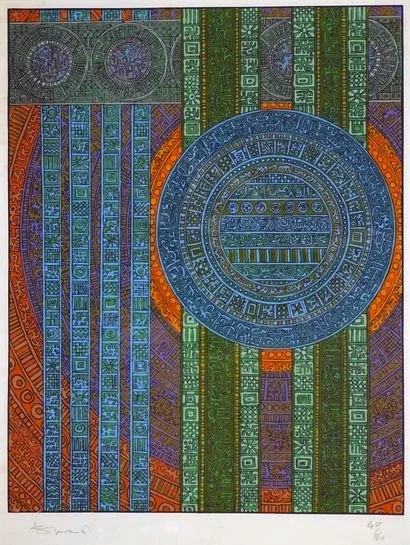
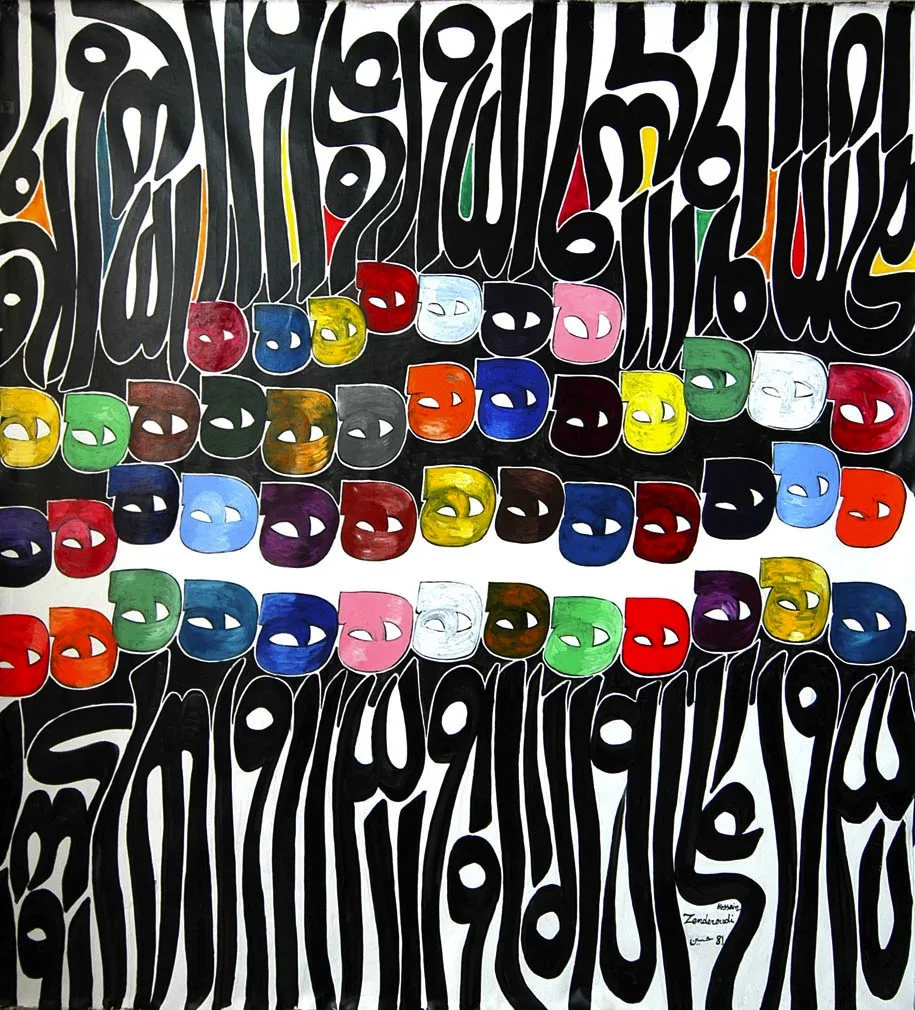
This study adopts a descriptive-analytical method and a qualitative approach to conduct a systematic investigation of five significant works by Hossein Zenderoudi (Untitled, Chaharbagh, Baraye Dasteh, Ghous-e Abi-e Nilgoon, and Binam). These works were selected through purposeful sampling from the entire statistical population of the artist's Persian calligraphic paintings (naghashi-khatt), based on four criteria: representing the integration of tradition and modernity, diversity in the application of visual elements, a key position within the discourse of the Saqqakhaneh school/movement, and the expression of a creative perspective. Data were gathered through direct study of the visual structures and semiotic content analysis of the symbols.
 
Discussion and Conclusion
This study, through systematic analysis of five seminal works by Hossein Zenderoudi—a foundational figure of the Saqqakhaneh School—reveals the process of reinterpreting traditional visual elements (color, line, form, texture, space, shape) within the context of Iran's modernist art. Findings demonstrate that Zenderoudi employs a conceptual, multi-layered approach, placing Shiite religious symbols, elements of folk art, and Persian calligraphy not in opposition, but in dynamic dialogue with modern abstract forms.
       This sophisticated synthesis yields three key achievements: 1. The transition of script from linguistic to visual function: Particularly evident in Thuluth calligraphy, where script transforms from textual carrier into rhythmic structure within his works. Through compositional devices like the rhythmic repetition of the letter "Heh" (هـ) in Qoos-e Abi-ye Nilgoon, it represents sacred concepts such as cosmic infinity. 2. The redefinition of sacred geometry within contemporary aesthetics: Where basic forms like the circle (symbolizing unity of existence) and rectangle (referencing religious tablets) in the "Untitled" work employ warm/cool color contrasts. These simultaneously evoke traditional arabesques (Islimi) while harmonizing with modern abstraction. 3. The creation of a dual visual language: Exemplified in Baraye Dasteh (For the Hand), which merges expressive techniques (agitated brushstrokes, dark palette) with Shiite symbolism (broken ship = Ashura), depicting Iran's historical tension between tradition and modernity.
       A crucial aspect of this process is the transformation of indigenous elements into conceptual tools: The green (sanctity) and white (purity) in Baraye Dasteh are not mere decoration, but mediums conveying collective human grief and spirituality. Furthermore, the repetition of symbolic numbers (5, 7) in Chaharbagh (Four Gardens), by turning script into form, intricately links discourses of Islamic mysticism with abstract aesthetics. This approach establishes Zenderoudi as a bridge between Iran's cultural memory and global art. In Ghous-e Abi-e Nilgoon, the mathematical infinity symbol (∞) is redefined through the Persian letter "Heh," remaining faithful to Eastern mythology while speaking the universal language of abstract art. On a broader level, this research proves that the Saqqakhaneh School, spearheaded by Zenderoudi, transcends mere imitation. It provides a paradigmatic model for artistic identity formation in transitional societies: an art rooted in its own cultural geography (public water dispensers/Saqqakhanehs, talismanic writing, occult sciences) yet, through critical reinterpretation of visual elements, integrates them into the contemporary global vocabulary. This success lies not in rejecting tradition nor surrendering to modernism, but in revitalizing indigenous signs as conceptual signatures. Consequently, Zenderoudi not only enriched the discourse of Iranian art but also created a theoretical framework for global artists seeking to synthesize local heritage with artistic meta-narratives. Along this path, ancient visual elements, imbued with novel conceptual systems, became innovative tools to counter global aesthetic uniformity.

Keywords

Subjects
·         Amani, Hojjat. (2020). “Changing the Meaning in the Discourse of Contemporary Iranian Calligraphy from the Perspective of Critical Discourse Analysis”. Honar va Tamaddon-e Sharq. (Vol. 31). 51-62.
·         Afsharmohajer, Kamran. (2005). Iranian Artist and Modernism. Tehran: Honar University.
·         Ebrahimi Naghani, Hossein. (2010). “Saqakhaneh movement; Disclosing and unveil of aesthetic Experience contrivance and contraption of Iranian traditional, ethnic and ancient art”. Honar-ha-ye Ziba (Honar-ha-ye Tajassomi). (Vol. 41). 39-53.
·         Bageri, Negar. (2023). “Tracing Neo-Traditionalism in Twelve Paintings from the Saqqakhaneh Movement”. Rahpouye-ye Hekmat-e Honar. (Vol. 2). 119-131.
·         Baniardalan, Esmaeil. (2019). “A Semiotic Analysis of Hossein Zenderoudi's Calligraphic Paintings (Based on Peirce's View)”. Dastavardha-ye Novin dar Motale'at-e Olum-e Ensani. (Vol. 17). 24-29.
·         Davoudi Abkenar, Arman. (2023). “Genealogy of the Calligraphic Designs in the Saqqakhaneh Movement”. Paykareh. (Vol. 33). 21-35.
·         Ghazi, Seyyedeh Maryam. (2016). “Analysis of Visual Elements in Saqqakhaneh Painting”. Master's Thesis. Tehran: Islamic Azad University.
·         Goudarzi, Morteza. (2001). The History of Iranian Painting from the Beginning to the Present Era. Tehran: Honar.
·         Garoossi, Atefeh. (2020). “Re-reading the artworks of Saqakhaneh painters from Shklovsky’s defamiliarization perspective (selected artworks of Oveysi, Qandriz and Tabrizi)”. Paykareh. (Vol. 22). 59-72.
·         Gol-Sabahi, Golnaz. (2013). “The Works of the Pioneers of the Saqqakhaneh School in the Treasury of Color and Form; Hossein Zenderoudi”. Farhang-e Muzeh. (Vol. 2). 45-46.
·         Hooshiyar, Afsoon. (2023). “A Study of Mythological, Traditional and Religious Motifs in Contemporary Calligraphy With Emphasizing The Works of Saqakhaneh Artists With an Intertextual Approach”. Jelve-ye Honar. (Vol. 68). 137-152.
·         Izadi, Abbas. (2016). “A Reexamination of Saqqā-ḵāna Painting from the View of Gadamer Hermeneutics”. Honar-ha-ye Ziba, Honar-ha-ye Tajassomi. (Vol. 21). 21-30.
·         Karimi, Ali. (2025). “A Visual Semiotic Analysis of the Calligraphic Paintings of Hossein Zenderoudi and Hamidreza Gholichkhani (Based on Roland Barthes' View)”. Motale'at-e Honar-ha-ye Ziba. (Vol. 11). 14-24.
·         Keshmeshken, Hamid. (2012). “Lettrism and the Modern Calligraphic Painting Movement”. Honar-e Mo'aser. (Vol. 28). 28-35.
·         Keshmeshken, Hamid. (2017). Contemporary Art of Iran. Tehran: Nazar.
·         Keshavarz, Golnaz. (2020). “A Study of the Importance of Letterism in Contemporary Iranian Art (Case Study of Fajr Visual Arts Festival and Tehran Auction)”. Pazhuheshname-ye Graphik-e Naghashi. (Vol. 3). 191-202.
·         Khorshidian, Raika. (2016). “The Saqqa-khaneh School: Post-Colonialism or Orientalism Perspective?”. Bagh-e Nazar. (Vol. 53). 43-56.
·         Mohammadi Asl, Pouria. (2015). “An Introduction to the Place of the Saqqakhaneh School in the Modernism Movement of Contemporary Iranian Art, (With an Analytical Look at the Works of the Saqqakhaneh Artists)”. The Second National Conference on Art and Humanities with an Iranian Approach. Tehran.
·         Mahmoudi, Akram. (2023). “A Comparative-Analysis of Formalisitic Characteristics in the Paintings of the Coffeehouse and Saqqakhaneh Schools (Case Study: Abbas Boloukifar from the Coffeehouse School, Sadegh Tabrizi from the Saqqakhaneh School)”. Master's Thesis. Neyshabur: University of Neyshabur.
·         Moeini, Batool. (2023). “Analysis of Palm Icon of Abbas (AS) in the Works of Iranian Artists of Saqqakhana Movement Case Study: Parviz Tanavoli, Hossein Zenderoudi, Faramarz Pilaram”. Motale'at-e Tarikh-e Eslam. (Vol. 59). 126-148.
·         Mehrjooya, Masoumeh. (2016). “Formalistic Aesthetics of Hossein Zenderoudi's Works with a Formalistic Approach”. Master's Thesis. Tehran: Alzahra University.
·         Pakbaz, Ruyin. (2011). Iranian Painting from Long Ago Until Today. Tehran: Zarrin & Simin.
·         Pakbaz, Ruyin. (2020). Encyclopedia of Art. Tehran: Farhang-e Mo'aser.
·         Pashakhanlou, Fatemeh. (2017). “A Study of Visual Metaphors in Iranian Art (Case Study: The Works of Farideh Lashai, Bahman Mohasses, and Hossein Zenderoudi)”. Master's Thesis. Tehran: Honar University.
·         Pourmokhtar, Sediqeh. (2021). “A Comparative Study of Postcolonial Reading of by Saqqakhaneh School and Group D`s Paintings in Turkey Based on the Third space of Homi Bhabha”. Honar-ha-ye Ziba. (Vol. 26). 33-42.
·         Rahimi, Leila. (2023). “Investigating the Role of Talismans in Saqqakhaneh Paintings, Especially in the Works of Sadegh Tabrizi and Hossein Zenderoudi”. Master's Thesis. Isfahan: Sepahan Higher Education Institute.
·         Ravanjoo, Ahad. (2022). “A Survey on the Modernist Art Movement of Iran in Calligram (Based on the Orientation Towards Traditional and Modern Art Strains)”. Paykareh. (Vol. 28). 53-66.
·         Ravanjoo, Ahad. (2024). “Reviewing and Classifying the Painting-Calligraphy Work Stages of ‘Mohammad Ehsai’ Based on Traditional and Modern Calligraphy Approaches”. Paykareh. (Vol. 37). 1-19.