Analysis of Motifs and Dating of the Bronze Belt Housed in the Dafineh Museum Campus

10.22034/ciom.2025.2069961.1048

Document Type : Original Article

Author

دانش آموخته دکتری باستان شناسی دوران تاریخی

Abstract
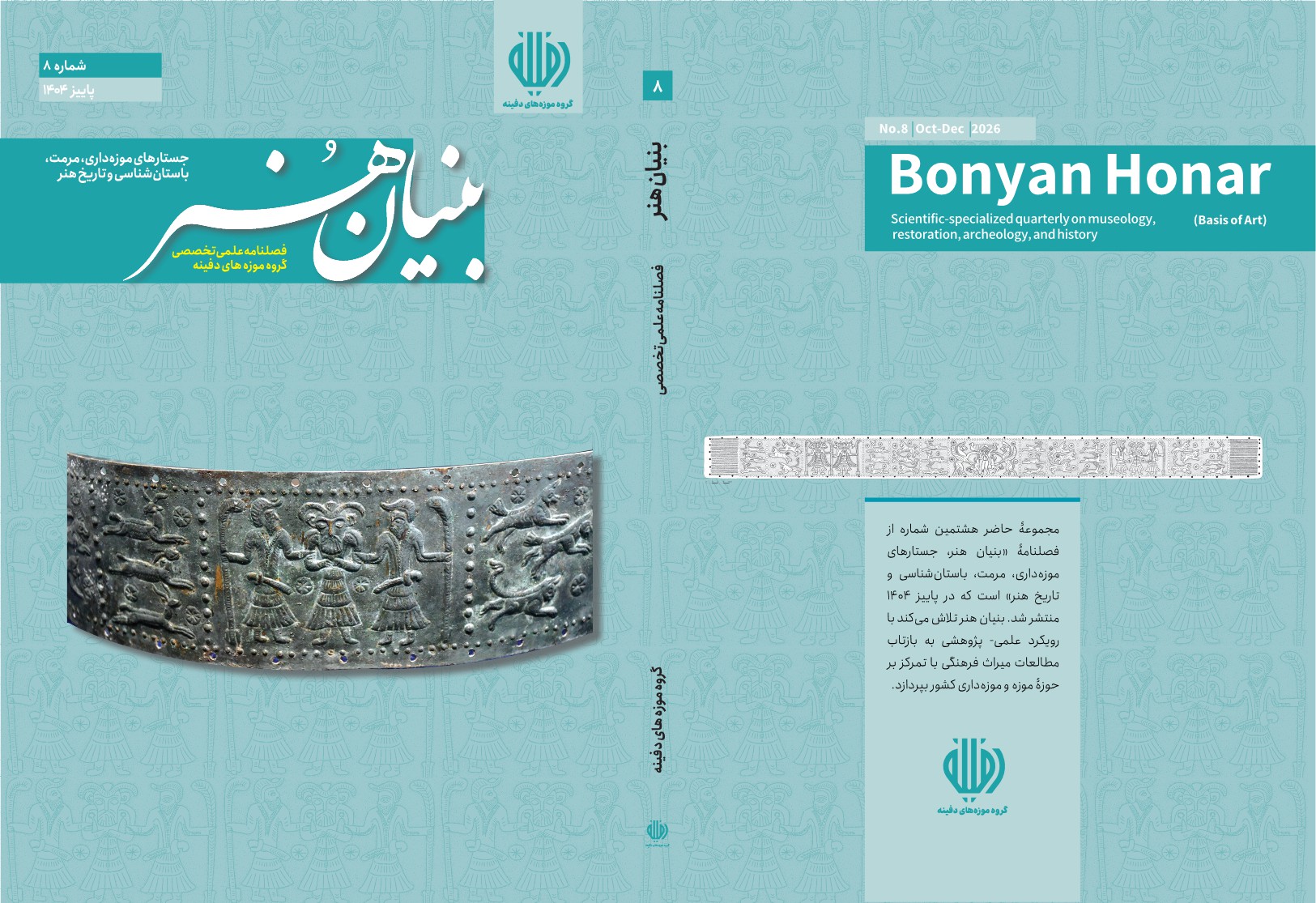
The bronze belt housed in the Dafineh Museum Campus is one of the discoveries from unscientific excavations and, due to its intact condition, is considered a unique specimen among other known belts. The bronze belt is a single sheet measuring 96 cm in length and 7.5 cm in width. Its surface has been divided into 15 panels using the techniques of hammering, engraving, and punching. These panels are filled with motifs of rope patterns, animal figures, and mythological scenes. The animal motifs include scenes of dogs pursuing gazelles, while the mythological depictions present three scenes: the capture of a demon, a half-human creature holding two hunted gazelles, and two mythical beings with three heads.
       Two fundamental questions arise regarding this belt: 1) Its dating, and 2) Its historical attribution. The objectives of this research are to introduce the belt, its decorations, and the techniques used, and to conduct an artistic stylistic analysis, dating, and historical attribution through an examination of its technical and artistic characteristics. The findings indicate that the subject matter of the motifs and the techniques of their execution bear significant resemblance to Luristan bronze artifacts, including votive plaques, dagger sheaths, quiver covers, and pinheads. Based on these similarities, the belt's origin is attributed to the Luristan region during the 1st millennium BCE, reflecting the region's rich cultural history and distinct identity. The research methodology of this article is descriptive-analytical and based on library studies.
Artifact Introduction:
The examined belt, with catalog ID 44387, is a one-piece bronze artifact. It measures 96 cm in length, 7.5 cm in width, and has a thickness of 30.5 cm, and is in good condition. Irregularly spaced holes along the top and bottom edges suggest it was likely attached to a leather or fabric backing. Additionally, holes at the junction of the belt's two ends were made for fastening them together.
The belt comprises 15 panels. The two panels at each end are decorated with rope-pattern motifs. Ten panels feature animal motifs, and the three central panels contain mythological scenes.
The animal motifs consist of six scenes of fleeing gazelles and four scenes of pursuing dogs. These are arranged in a deliberate and meaningful pattern around the three main scenes, conveying the message that these three central figures constitute the belt's primary subject.
1. The First Mythological Scene: This depicts the capture of a demon(?) by two guards (Image 3). The guards are bearded, mustachioed men. Their faces and legs are shown in profile, while their torsos are depicted frontally. They wear brimmed hats/helmets and long, layered, pleated robes. Each guard has a dagger in a sheath at his waist. With one hand, they each hold the hands of the demon(?), and in the other hand, they hold a jarideh[1] (a type of javelin or mace). In contrast to the guards, the demon(?) is shown frontally, wearing a layered, pleated garment.
2. The Second Mythological Scene: Positioned at the center of the belt, this scene features a semi-human creature with a gazelle's head and a human body. It holds two gazelles by their legs, a motif that connects thematically with the scenes of fleeing gazelles. Two winged creatures flank the semi-human figure. In the upper part of the panel, two ducks or vultures, positioned back-to-back, stand on the hands of the winged creatures.
3. The Third Mythological Scene: This image depicts two men with three heads. The men have large eyes, long mustaches and beards, and wear horned(?) headgear. Two ram/goat heads are visible on either side of their human heads. The men hold jarideh, which have square-shaped bases. It appears these two individuals may be priests or religious dignitaries.
 
Dating of the Bronze Belt
Based on Godard's (Godard,1998: 73-77) proposed chronology for Luristan pins and plaques (with religious themes), we are dealing with two categories of objects. The first category dates from the second half of the 2nd millennium BCE to the beginning of the 9th century BCE, where the artifacts show influence from the Elamite art of the Untash-Huban period. The second category dates from the 9th century BCE to the beginning of the Achaemenid period, where the artifacts were influenced by Assyrian art (from the time of Ashurnasirpal II onward). The presence of Assyrian motifs such as palmettes, the barsom, winged creatures, etc., on Luristan pins indicates imitation of Assyrian art, whether by Assyrian artisans themselves or by local craftsmen trained under their influence (ibid., 72). These influences are observable in the motifs of the belt.
       Moorey (1967:92) notes that the influence of certain motifs first appeared on Babylonian and Elamite seals and later on Luristan bronzes, indicating the adoption of these motifs by the bronze workers of the Luristan region in the early 1st millennium BCE. Regarding the Luristan bronzes, Herzfeld considered them to be the work of local artisans in the Iranian region who had accepted influences from neighboring cultures (Hojebri and Sabzi, 2011:169). Dolati and Molazadeh (2018: 89), through their study of the creators' identity at the Surkh Dom Lori temple site, attribute the bronze artifacts from this location to the Ellipi kingdom and associate them with the Kassite people in the 9th century BCE.
       Linguistic data indicate that the inhabitants of the Luristan region were the Kassites, who were present in the area from the mid-3rd millennium BCE. These peoples laid the necessary groundwork for the establishment of the Ellipi kingdom in the 1st millennium BCE. The earliest reference to Ellipi pertains to a short inscription from the 18th year of the reign of Ashurnasirpal II, in 866 BCE, which records the first documented encounter between Assyria and Ellipi. It can be confidently asserted that the formative stages of this kingdom date back to an even earlier period (Molazadeh and Gudarzi,2016:85). In a report by Sennacherib from 703 BCE, reference is made to the rule of Ellipi and Kassite names, with linguistic studies indicating that the majority of the inhabitants of the Ellipi kingdom were Kassite speakers (Zadok, 2002:127). According to linguistic data, the Kassite people were among the indigenous groups of the region who continued to live in the land of the Kassites even after the collapse of the Ellipi kingdom.
       In addition to animal husbandry and agriculture, the Kassites were also engaged in metallurgy. The historical and geographical distribution of the discovered bronzes coincides with the geographical extent of the Ellipi kingdom, supporting the theory that a major portion of the Luristan bronzes was the product of Ellipi metalworkers (Molazadeh and Gudarzi,2016:95).
Based on this, the bronze belt, with its similarities to artifacts from the Luristan region, is attributed to local artisans who accepted influences from neighboring cultures. A probable dating for the belt, relying on Muscarella's (Muscarella, 1988:201) proposed dating for a quiver cover, is the late 8th to early 7th century BCE.
 
Conclusion
Luristan bronzes hold a distinguished place in archaeological and art historical studies as one of the most prominent artistic and cultural achievements of ancient Iranian civilizations. These artifacts, dating from the early 3rd millennium to the 1st millennium BCE, represent the technical skill, artistic creativity, and mythological beliefs and ritual practices of the peoples of western Iran.
The bronze belt from the Dafineh Museum Campus, discovered through unscientific excavations, is a unique specimen among other known belts in Iran due to its complete state and exceptional decorations. The belt features repetitive animal motifs and three mythological scenes.
In terms of its motifs and execution style, the bronze belt shows similarities with votive plaques, dagger sheaths, and pinheads attributed to sites in Luristan, particularly the Surkh Dom Lori site. The strongest parallels are with a quiver cover discovered in Luristan, now housed in the Metropolitan Museum of Art, whose three main scenes correspond directly to those on the belt. The mythological scenes are connected to the Gilgamesh epic, a detailed analysis of which falls outside the scope of this article
       Consequently, the belt's origin can be attributed to the Luristan region. Based on comparisons with the aforementioned artifacts, its dating is proposed to be the 1st millennium BCE. This period coincides with the rule of the Ellipi kingdom over the Luristan territory, indicating that the belt's creators were the indigenous inhabitants of Luristan. This claim is supported by sites such as Surkh Dom Lori and Sangtarashan, which provide substantial evidence of professional and specialized metalworking activities.


[1] - A long, leafless branch of a palm tree is called - Dehkhoda Dictionary

Keywords

Subjects
-        Amiet, Pierre (1968), Antiquités iraniennes récemment acquises par le Musée du Louvre, Syria, 45, Fasc. 3/4, P: 249-262.
-        Beiranvand, YosofAli, and Mohammad Mirzai Rashnoo (2021). "A Study of the Binary Opposition of Symbols in Zurvan Myth of Lurestan." Journal of Comparative Theology, Vol 11, Issue 24, pp. 113–124. Doi: 10.22108/coth.2021.122789.1402
-        Calmeyer, Peter (1997). Datable Bronzes of Luristan and Kermanshah. Translated by Mohammad Asemi. Tehran: Cultural Heritage Organization of Iran. (in Persian)
-        Cifarelli, Megan, Kazem Molazadeh & Ali Binandeh (2018), A Decorated Bronze Belt from Gargul, Iran, Iran, DOI: 10.1080/05786967.2018.1505441
-        Culican, William (2006). Archaeology and Art History in the Median and Persian periods. Translated by Goodarz Asad Bakhtiyar. Tehran: Pazineh Publications, 2nd Edition. (in Persian)
-        Danti, Michael and Megan Cifarelli (2015), Iron II Warrior Burials at Hasanlu Tepe, Iran, Iranica Antiqua, vol. L, doi: 10.2143/IA.50.0.3053517
-        Dercksen, J. G. (2005) Metals according to documents from Kültepe-Kanish dating to the Old Assyrian Colony Period. In Ü. Yalçın (ed.), Anatolian Metal III, 17–34. Bochum: Deutsches Bergbau-Museum.
-        De Morgan, Jacques (1927), La préhistoire orientale. Tome III: L'Asie antérieure. Published by Librairie orientaliste Paul Geuthner, Paris. Vol: III
-        Dolati, Maryam and Kazem Molazadeh (2018). "The Historical Identity of the Sorkh Dom Lori’s Temple and the Nature of Its Creators." Journal of Cultural History Studies; Research Journal of the Iranian History Association, Volume 9, Issue 35, pp. 71–92.
-        Frankfort, Henri (1939), Cylinder Seals- A Documentary Essay on the Art and Religion of the Ancient Near East, London, Macmillan and Co.
-        Ghirshman, Roman (2011). Iranian Art in the Median and Achaemenian Periods. Translated by Issa Behnam. Tehran: Scientific and Cultural Publications, 3rd Edition. (in Persian)
-        Godard, André (1998). Bronze Objects of Luristan (Les bronzes du Luristan). Translated by Behrouz Habibi. Tehran: Shahid Beheshti University Publications. (in Persian)
-        Goff, Clare (1969), Excavations at BāBā Jān, 1967: Second Preliminary Report, Iran, Vol. 7, pp. 115-130
-        Henrickson, C. Robert (2011), the Godin Period III Town, “On the High Road: The History of Godin Tape, Iran”. Edited by Hilary Gopnik & Mitchell Rothman, Royal Ontario Museum, pp: 209-282.
-        Hojebri Nobari, Alireza, and Musa Sabzi Doabi (2011). "Rod-shaped Pins of Luristan." Journal of Historical Sociology, Vol 3, Issue 2, pp. 165–188.
-        Hojebri Nobari, Alireza, Zahra Kouzegari, Seyed Mehdi Mousavi and Kamaleddin Niknami (2015), A Chronological Overview of Some Ziwiye Belts, Sociology and Anthropology 3(3): 186-192, DOI: 10.13189/sa.2015.030306
-        Majidzadeh, Yousef (1988). "Dating the Luristan Bronze Disc-Headed Pins." Journal of Archaeology and History, Vol. 3, No. 1, pp. 3–15.
-        Malekzadeh, Mehrdad (2006). Preliminary Descriptive Report of the First Three Seasons of Rescue Excavations at Sangtarashan, Khorramabad, Luristan. Archaeological Research Institute, Cultural Heritage Organization, and the Cultural Heritage Department of Luristan Province. (Unpublished).
-        Mansourzadeh, Yousef (2018). " The survey of the role of Gilgamesh on the art of the Lorestan Bronze works" Journal of Visual and Applied Arts, Vol 11, Issue 21, pp. 85–100. Doi:10.30480/vaa.2018.675
-        Meldgaard, J., Mortensen, P., & Thrane, H. (1963). Excavation at Tepe Guran, Luristan, preliminary report of the Danish Archaeological Expedition to Iran. Acta Archaeologica, Vol 34, pp: 97-133.
-        Michel, Cécile (2020), “Belts and Pins as Gendered Elements of Clothing in Third and Second millennia Mesopotamia”. In Textiles and Gender in Antiquity from the Orient to the Mediterranean. Edited by: Harlow, Mary; Michel, Cécile; Quillien, Louise., Bloomsbury, pp: 179-192
-        Molazadeh, Kazem, and Alireza Gudarzi (2016). "Historical Geography of the Ellipian Kingdom." Journal Archaeological Research of Iran, Vol 6, Issue 10, pp. 83–100. Dio:10.22084/nbsh.2016.1548
-        Moorey, P.R.S (1967), Some Ancient Metal Belts: Their Antecedents and Relatives, Iran, Vol.5, pp. 83-98.
-        Moorey, P.R.S (1975), Some Elaborately Decorated Bronze Quiver Plaques Made in Luristan, c. 750-650 B.C, Iran, Vol.13, pp. 19-29.
-        Muscarella, O.W (1974), Decorated Bronze Beakers from Iran, American Journal of Archaeology, Vol.78, No.3, pp. 239-254.
-        Muscarella, O.W (1988), Bronze and Iron: ancient Near Eastern artifacts in the Metropolitan Museum of Art, Metropolitan Museum of Art.
-        Negahban, Ezat O (1995), Weapons from Marlik, Berlin. D.Reimer
-        Overlaet, Bruno (2003), The Early Iron Age, in the Pusht-I Kuh, Luristan, translation by Kamal Alden Niknami and Amir Saed Mucheshi, first impression, Tehran, Samt Publications, (in Persian).
-        Peck, E.H )2002(, A decorated bronze belt in the Detroit Institute of Arts, in: E. Ehrenberg (ed.), Leaving no stones unturned: Essays on the Ancient Near East and Egypt in Honor of Donald P. Hansen, Winona Lake, IL: Eisenbrauns. pp. 182–202.
-        Prell, Silvia (2019), Buckle up and Fasten that Belt, Metal Belts in the Early and Middle Bronz age, dag Ägypten und Levante/Egypt and the Levant 29, pp:303–329
-        Porada, Edith (1948), Nomads and Luristan Bronzes, Dark Ages and Nomads, C. 1000 B. C. Ed. M. J. Melink. Nederlands Historich Archaeologisch Institute, Istanbul.
-        Sadeghi, Sara, Ardeshir Javanmardzadeh, Manijeh Hadian Dehkordi, and Reza Rezaloo (2023). "Study and Introduction of Motif Morphology in the Colored Paintings of Luristan Province (With an Emphasis on the Dog Motif)." Journal of Iranian Indigenous Knowledge, Vol:10, No. 19, pp. 344–379.
-        Schmidt, E.F, M.N VanLoon and H.H Curvers (1989), The Holmes Expeditions to Luristan, The University of Chicago: Oriental Institute Publication.
-        Shahbazi Shirvan, Habib, Zahra Cheraghi, Mozhgan Rostami, and Ardeshir Javanmardzadeh (2024). "A Study of Animal Motifs on Artifacts from Luristan from the Past to the Contemporary Era Considering the Geographical Conditions of the Region." Journal of Geography and Human Relations, Volume 7, Issue 1, pp. 18–41.
-        Shepherd, Dorothy G (1966), Four Early Silver Objects from Iran, The Bulletin of the Cleveland Museum of Art, Vol.53, No.2, pp: 38-50
-        Sumner, William (1974), Excavations at Tall-i Malyan, 1971-72, Iran, Vol. 12, pp. 155-180.
-        Talai, Hassan (2011). Prehistoric Iran: The Chalcolithic Age. Tehran: Samt Publications. (in Persian)
-        Vanden Berghe, Louis (1964), La nécropole de Khūrvīn. Nederlands Histor-isch-Archeologisch Instituut in het Nabije Oosten te Istanbul, XVII
-        Vanden Berghe, Louis (1968), Het archaeologisch onderzoeknaar de bronscultuur van Luristan, opgravingen in Pusht-I Kuh I, Kalwali en War Kabud (1965 en 1966), avec un resumefran-ais: Les recherches archaeologiques dans le Luristan, fouil es dans le Pusht-I Kuh, Kal wali et War Kabud, Brussel.
-        Vanden Berghe, Louis (1969). Archaeology of Ancient Iran. Translated by Issa Behnam, 2nd Edition. (in Persian)
-        Zadok, Ron (2002), The Ethno-Linguistic Character of Northwestern Iran and Kurdistan in the Neo-Assyrian Perio, Iran: Journal of the British Institute of Persian Studies, Vol 40, pp: 89-151
-        www.britishmuseum.org